




01 / Show notes
DeepSeek | Search APIs | Personal websites | AI games | Device tinkering | AI security | Vibe Coding | Personal agents | Grok Bot | Omarchy | AI hardware
🎧 About this episode
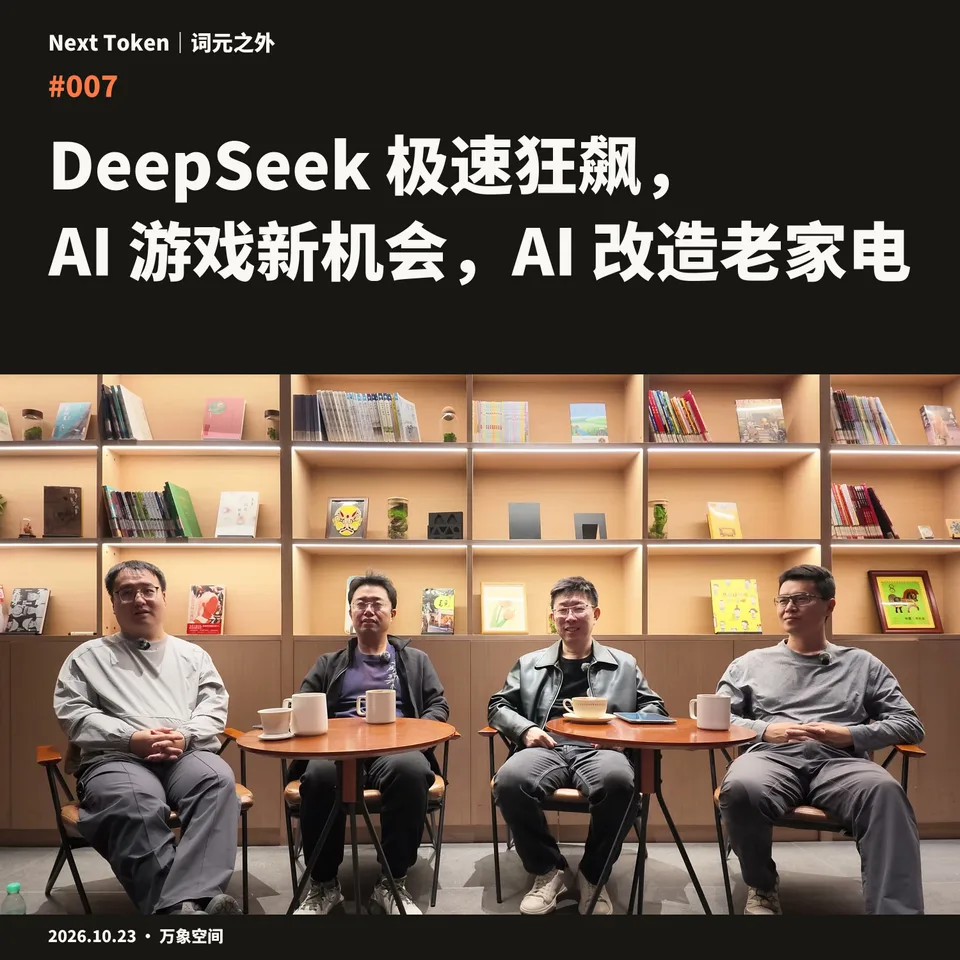
DeepSeek answers fast enough to change the experience of waiting for a response. Search APIs bring Chinese information into personal agents. Browser games become more complete, and an old TV gets a new launcher. Starting from these hands-on experiences, we discuss how AI is changing software, content and the devices around us.
From console-game ports and custom editing tools to Codex and Grok Bot in the living room, there is more we can build ourselves. Alongside that freedom come questions about vulnerabilities, certificates and API keys: how should individuals and teams respond?
In the second half, we ask whether vibe coding saves time or makes creating things enjoyable in its own right. Transcribing hundreds of podcasts, catching missed Slack discussions, organizing WeChat contacts and connecting a voice device to a personal agent all lead to a bigger question: with enough intelligence and tokens, what would you try?
🎙️ Host and participants
- Guizang — this episode’s host
- Xiangyang Qiaomu
- Yang Pan
- Orange
Recorded on October 23, 2026, at Wanxiang Space.
⏱️ Timeline
- 00:00 Highlights
- 01:25 Intro
Faster DeepSeek, search and software experiences
- 02:15 Opening: ten thousand listeners and four hosts
- 02:52 How DeepSeek inference speed changes the experience
- 08:57 Search APIs: Chinese information for a personal agent
- 13:28 Agent traffic, personal websites and open interfaces
- 18:29 Building editing tools: automation and rendering waits
Making games and reworking old devices
- 20:52 AI games: ports, browser games and progression loops
- 27:13 Create once, enjoy repeatedly without repeated token costs
- 32:23 Console ports and platform security
- 34:59 Rebuilding a TV launcher to connect old devices with AI
Stronger capabilities, new security questions
- 39:08 Security: vulnerabilities, certificates and patches
- 42:04 Passwords, passkeys and changing devices
- 46:01 Leaked keys and security boundaries in the AI era
What do we want to do with better AI?
- 52:04 Vibe coding: productivity or a creative game?
- 55:16 What is worth learning: asking AI and talking to people
- 58:42 Duet and model companies’ product choices
- 01:00:45 When AI writes the code, how do we learn architecture?
- 01:03:04 Work without watching the computer: ask for the result
- 01:06:33 Bigger tasks: podcasts, Slack and WeChat
- 01:10:10 What would you do with unlimited intelligence and tokens?
- 01:12:22 Omarchy, old phones and rewriting software
- 01:16:00 Voice and small devices as personal-agent interfaces
- 01:19:05 Closing: the changes continue
💡 Questions to take away
Can speed change what we expect from software?
The discussion moves from inference speed to search and reading documents aloud. Shorter waits may change whether people need to think about the steps behind a tool at all.
Why is the opportunity in AI games bigger than games that use AI at runtime?
PokeBonk, console ports and browser distribution suggest a different cost structure: use intelligence to create something that people can enjoy repeatedly. Taste, experience and distribution still matter.
Can security keep pace with lower barriers to building?
The speakers discuss reported vulnerabilities and leaked credentials, then return to everyday habits: managing passwords, recovering them after changing devices and deciding what permissions to give an agent.
Is vibe coding work, or a new kind of creative game?
Buying tokens can feel like spending on a game. The conversation considers the pleasure of building, alongside the value of asking good questions, developing judgment and working with people.
What would you do with enough intelligence and tokens?
The practical examples encourage a bigger starting point: describe the result you want and give the agent room to complete it.
🧩 Concepts
- Token: A basic unit of model input and output; discussed in relation to speed, usage and production costs.
- API: An interface that lets software call a capability, such as search.
- Personal agent: An AI assistant using personal context, memory and tools to act on tasks.
- Harness: The surrounding system for tool calls, task loops and context management.
- Vibe coding: Building software through repeated natural-language collaboration with AI.
- Skill: Reusable task instructions and resources for an agent, potentially including scripts and assets.
- Save time / kill time: Two experiences discussed in the episode: efficiency and enjoying the activity itself.
🔗 Tools and sources mentioned
- DeepSeek — inference, search and API experiences.
- Umami — open-source website and agent-traffic analytics.
- Omarchy — Linux, agents and modifying devices.
- FoloToy — AI hardware and modification ecosystems.
🔁 Related episode
- Episode 006 — AI reverse engineering, Grok Bot, Muse and multi-agent collaboration.
💬 Join the conversation
With enough intelligence and tokens, what would you try that previously seemed out of reach? Does your vibe coding mostly save time, or do you enjoy the process of creating?
About the show
Next Token is a video podcast about AI technology, products and their real-world impact, also available in audio. Next Token Weekly brings together Yang Pan, Guizang, Orange and Xiangyang Qiaomu for a weekly roundtable of observations, practical experiences and different perspectives.
Music
“Electric Dreams” and “Origami” by Scott Buckley, released under CC BY 4.0. Edited and mixed for Next Token Weekly.