01 / Show notes
🎧 Overview
A single HTML file can hold more than 20 3D models, along with animations, textures, and a soundtrack. At 8 MB, it can even run on a phone. Guizang shares what happened when he used Fable 5.2 for a game and an interactive ink painting. Scenes and camera angles came together quickly. Making combat feel right took more rounds of feedback. As AI raises the starting point for creative work, what does good judgment look like? What can creators build on once the work itself becomes easier to copy?
The episode opens with Jensen Huang’s departure as NVIDIA’s president, CEO, and board member. The four hosts share memories of NVIDIA and discuss what its leadership transition could mean for AI compute and gaming GPUs. They then consider how language connects games and robotics, compare their experiences with Gemini 4 Carbon, and revisit the instructions they give models as those models become more capable.
A trip planned with Instinct brings the conversation to personal agents. An agent can remember preferences, send timely reminders, or help coordinate a shared itinerary. Each useful action can earn more trust and access, which raises questions about accounts and sensitive data. The hosts close with Seedream 5.5, Jimeng’s creative tools, recent purchases, and how Next Token Skill finds passages from the show.
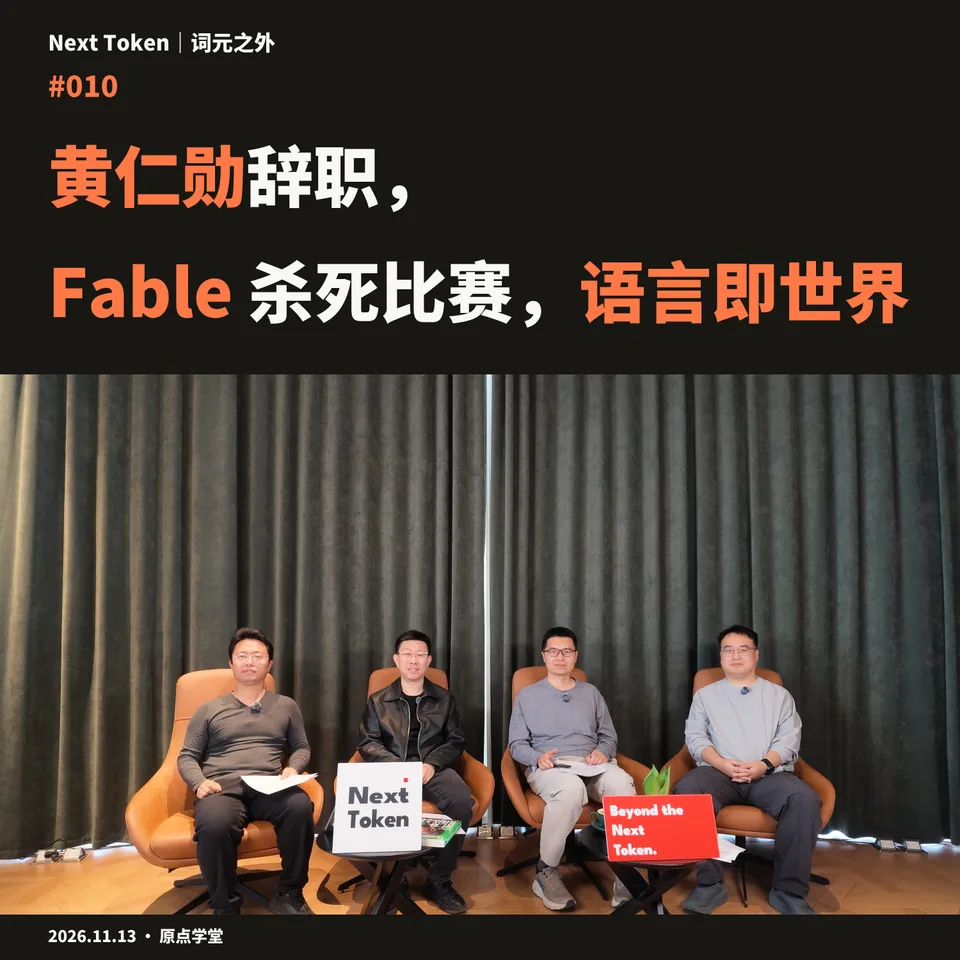
🎙️ Hosts
- Xiangyang Qiaomu · Duty host
- Yang Pan
- Orange
- Guizang
Recorded on November 13, 2026, at Genesis Academy in Wudaokou, Beijing.
⏱️ Audio chapters
- 00:00 Highlights
- 02:34 Intro
Jensen Huang and the future of AI computing
- 03:23 Opening at Genesis Academy and updates from the show
- 04:15 Jensen Huang’s resignation and memories of NVIDIA
- 06:27 What could an executive transition mean for AI compute and gaming GPUs?
Fable: making things, judging them, and finding value
- 08:32 Fable 5.2 builds scenes and shots, while combat feel takes iteration
- 11:42 Packing 3D models, animation, and music into one HTML game
- 13:24 From over 100 MB to 8 MB, a browser game reaches mobile players
- 17:14 How Fable raises the bar for painting, games, and visual design
- 21:46 Interactive ink painting and the difference between making and copying
- 23:53 What still makes a designer valuable?
- 26:26 Dinosaurs, fluids, and ancient Babylon as reusable virtual worlds
- 30:45 From building a dream project to finding real demand
- 33:47 Audience trust, distribution, and what survives imitation
- 36:41 Iteration and open-source communities beyond the code
Language as world and working with models
- 39:37 From games to robotics, what does “language is the world” mean?
- 45:05 Capability curves, AGI forecasts, and real-world data
- 48:25 Giving models ownership of projects and revisiting old skills
- 52:02 How Carbon writes, designs, and codes
- 56:36 Harnesses, product experience, and cloud access
Personal agents, trust, and product design
- 01:01:03 Chinese models and office tools designed around agents
- 01:03:14 How personal agents earn trust through travel planning with Instinct
- 01:06:06 Where agents can go on the open web and inside closed platforms
- 01:07:45 Multiple agents coordinate a trip and build a shared map
- 01:10:34 Account access, sensitive information, and misplaced trust
- 01:12:21 Commercial entry points, super apps, and product inertia
- 01:15:05 The Mythical Man-Month in the AI era and the cost of extra features
Image creation, recent purchases, and searching the show
-
01:17:41 Multiple models in Doubao and balancing consistency with creativity in Seedream 5.5
-
01:21:29 Jimeng’s canvas, agents, and a CLI for creators
-
01:24:46 Recent picks: blackout film, down jackets, and GTA VI
-
01:27:52 Searching past transcripts and jumping to Bilibili or YouTube
-
01:29:54 Citing the show with Next Token Skill and Grok Bot
-
01:30:49 Closing
💡 Questions from the episode
- Where does a designer’s judgment show up? Given ten plausible options, the ability to select one and explain why it works still shapes the product.
- What can creators build when copying becomes easier? Obsidian and OpenDesign lead into a discussion of continued iteration, audience trust, distribution, and open-source contributors.
- How much access should a personal agent get? Shared maps and travel reminders lead to questions about account access, sensitive information, and when a product should ask for permission.
- When should an image model preserve details or try something new? The hosts discuss visual consistency for commercial images and the room they want models to explore when testing a new style.
🧩 People, products, and concepts
- Jensen Huang and NVIDIA · The leadership transition, AI compute, and gaming GPUs.
- Claude Fable 5.2, Blender, and Tripo · Game prototyping, 3D assets, and rigging.
- Gemini 4 Carbon and Hydrogen and Antigravity · Writing, coding, and working with the models.
- Personal agents and Agent Skills · Agents build up context and preferences over time. Skills capture instructions and practices that can be reused across tasks.
- Harness and MVP · A harness organizes the tools and execution around a model. An MVP uses a minimal implementation to test a product assumption.
🔗 References
- NVIDIA’s CEO transition announcement
- Anthropic on Claude Fable 5.2
- Google Antigravity on Gemini 4 Hydrogen and Orchestrator
- ByteDance Seed on Seedream 5.5
- Next Token Skill source and installation · Search episode transcripts and articles from an agent and retrieve the relevant timestamps on Bilibili or YouTube.
Credits
Thanks to Genesis Academy for hosting the recording.