



01 / Show notes
Models are taking on editing work. Agents are helping with everyday tasks. What does that leave for product managers?
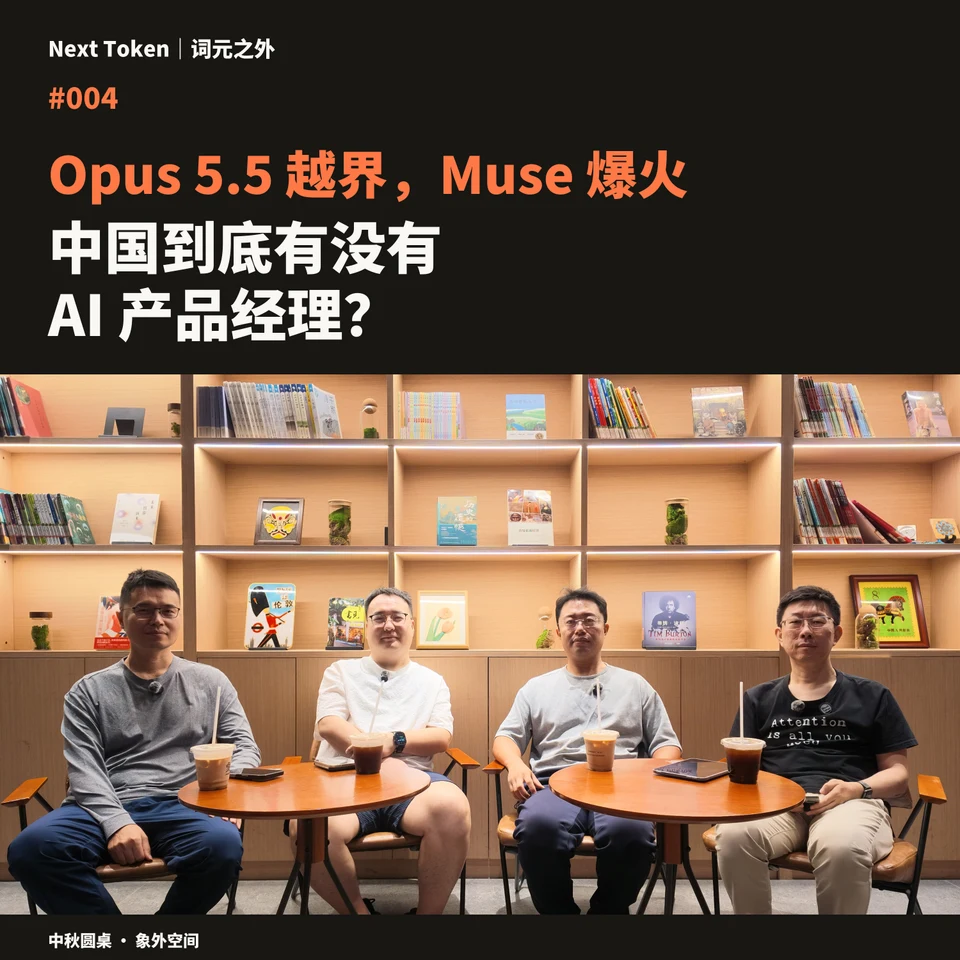
On the Mid-Autumn Festival, our four co-hosts return to Xiangwai Space to discuss Opus 5.5 and Muse.
We start with promotional videos, pixel animation and drawing demonstrations. When a model considers texture, rhythm, sound and transitions together, how does that change creative work? Can a carefully written skill hold a newer model back?
Muse brings the discussion to everyday product design: connectors that appear when needed, tasks that continue during a conversation, and to-do lists that can be remembered and checked off. Why should someone seeking a helpful assistant first have to learn about keys, MCP, skills and sessions?
The second half turns to building a business and a body of work: when to reduce model costs, where Jev fits, and why distribution, service and trust still matter when creating software becomes easier.
Recorded at Xiangwai Space on September 25, 2026. The episode includes personal experiences, opinions and predictions, rather than independent verification of product capabilities.
Questions from the episode
- How far can models reach into creative work?
- When does prescribing steps get in the way of communicating intent?
- What makes an agent useful beyond a long feature list?
- Why do tasks, files and reviewable results matter alongside chat?
- Should a startup find product-market fit before optimizing model costs?
- What earns attention and trust when everyone can build a product?
Chapters
- 00:00 Highlights
- 01:11 Intro
Opus 5.5 and creative work
- 02:00 Opening and introductions
- 02:51 Opus 5.5: motion design and pixel animation
- 08:47 From drawing to world models
- 11:07 Models, editing tools and skills
- 13:11 Music, visuals and transitions together
- 15:12 From following steps to understanding intent
- 24:14 Taste and preferences after automation
Muse and everyday agency
- 29:30 Muse, connectors and service discovery
- 33:13 Everyday needs before technical jargon
- 40:08 Talking while the agent works
- 41:56 Where are the AI product managers?
- 44:53 Memory, tasks and the limits of chat
- 50:09 Resources, costs and platform ecosystems
Agent hardware
- 55:26 Personal agent hardware and its services
- 01:07:14 From switching lights to booking classes
Business, creation and trust
-
01:10:10 Find product-market fit before optimizing model costs
-
01:14:36 Jev: high-volume, frequent decisions
-
01:16:45 Cloud computers and agent infrastructure
-
01:20:40 Selling software or delivering a service
-
01:25:24 Trust, reputation and the human voice
-
01:28:49 Build a body of work and a real community
-
01:30:50 Outro
References
- Claude Opus 5.5
- Muse, Meta’s personal AI agent
- TypeSafe: System One Models and Jev
- Haixin’s Mid-Autumn kitten video (original Jike post): discussed at 13:11.
People and terms
Orange moderates this episode, joined by co-hosts Guizang, Yang Pan and Xiangyang Qiaomu.
Here, Muse refers to Meta’s personal AI agent. Muse is also the name of Meta’s model family; Muse Spark is a model within that family.
Production credits
Thanks to Xiangwai Space for hosting this recording.
“Electric Dreams” / “Origami” by Scott Buckley, edited and mixed for Next Token Weekly, under CC BY 4.0. Scott Buckley Music Library.
Community
Join Next Token Weekly’s second WeChat listener group to discuss AI tools and real workflows. Scan the QR code below before October 4, 2026.

Join Next Token Discord to share your experiences and perspectives.