




01 / Show notes
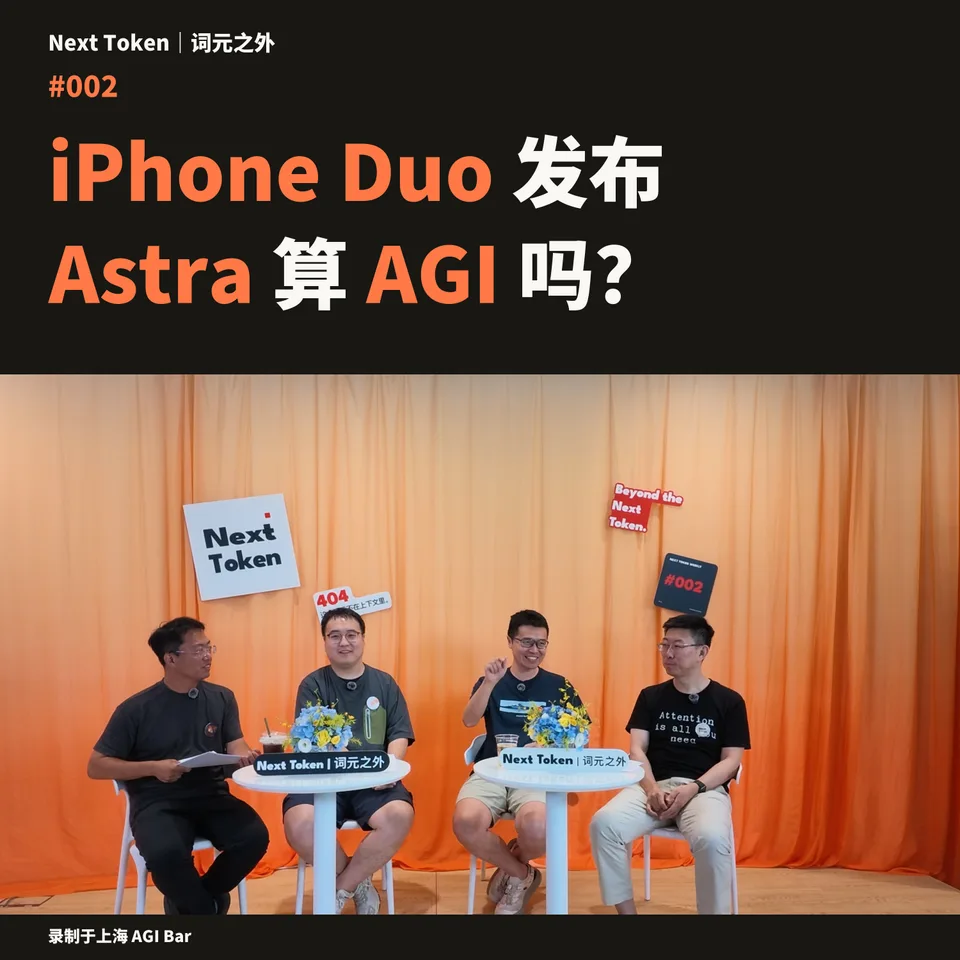
What new interactions could iPhone Duo and a foldable screen enable? Meanwhile, Astra can operate a computer and use tools to complete tasks. Does that count as AGI?
The episode follows two threads: the iPhone Duo launch and whether Astra counts as AGI. Starting with hands-on GPT-6 Astra experiments in 3D modeling and Next Token’s podcast production workflow, the conversation explores the distance between completing tasks and general intelligence.
DeepSeek Flash and Harness raise another question: as models become faster, less expensive, and more capable, do testing, delivery and human judgment become the bottlenecks? The discussion then turns to cloud agents, persistent computers, agent APIs, and whether small teams should maintain their own frameworks or focus on data, interfaces, and concrete use cases.
The second half turns to foldable interfaces, consistent design standards, watches, personal context, music and image editing, voice input, and the disputed question of whether models really become less capable over time.
Recorded at AGI Bar in Shanghai on September 12, 2026. Experiences, opinions and predictions reflect the participants’ views, not independent verification of product capabilities. Consult official sources for current features and availability.
In this episode
- What interaction problems should foldable screens solve?
- Does using a computer and completing real tasks count as AGI?
- Where do human judgment and delivery still matter?
- Why do agents need an always-on computer?
- How should personal context and hardware respect privacy?
Timeline
- 00:00 Intro
From capability to workflows
- 00:49 Opening in Shanghai
- 01:44 GPT-6 Astra and 3D creation
- 04:45 Blender, code, and the right tools
- 09:17 Using agents to produce and publish a podcast
- 17:21 Does computer use make Astra AGI?
- 20:31 Different models, different writing experiences
Flash and Harness
- 21:54 Trying DeepSeek Flash and Harness
- 23:06 When speed shifts the bottleneck
- 24:41 Keeping workflows working through rapid updates
- 27:16 From model capability to testing and delivery
- 29:29 Model routing and stability
Agent products and infrastructure
- 34:15 Why agents need cloud computers
- 38:58 Agent APIs and maintaining a harness
- 44:51 Agents as a cloud service
- 48:29 Vertical applications: data, interfaces, and context
- 50:20 AI assistants inside existing platforms
Hardware and personal context
- 55:02 iPhone Duo launch: foldables and interaction design
- 59:26 Interface standards and consistency
- 01:06:40 Watches, recording, and personal context
- 01:09:48 Health context, usefulness, and privacy
Creative tools and real-world experience
-
01:16:02 Controllable music and image editing
-
01:18:57 Why design agents need execution environments
-
01:22:16 Temporary sessions versus persistent computers
-
01:23:06 Voice input beyond transcription accuracy
-
01:26:56 Do models get worse? Experience, routing, and evaluation
-
01:33:31 Different choices in model products
-
01:39:39 From code to physical objects with 3D printing
-
01:41:51 Closing and thanks to Shanghai AGI Bar
-
01:42:14 Outro
References
- DeepSeek Harness repository: the agent harness discussed in this episode.
- Godot: the game engine mentioned in the discussion.
- AGI Bar: official site for the recording venue.
People, products, and terms
- Computer Use: Agents operating computer interfaces to complete tasks; this does not mean every task must be performed through clicks.
- Harness: The software layer that organizes model tool use, execution environments, and task loops.
- Persistent environment: An environment that retains files and working state across sessions, unlike a temporary session.
- Discussion of AGI, apparent model regressions, and future product forms includes disagreement and speculation rather than verified conclusions. Health-related remarks describe personal experience and are not medical advice.
Production and thanks
Thank you to Shanghai AGI Bar for the recording venue, and to 赛博禅心 and 南乔 for inviting us.
“Electric Dreams” and “Origami” by Scott Buckley are released under CC BY 4.0. Edited and mixed for Next Token Weekly.