


01 / Show notes
🎧 In this episode
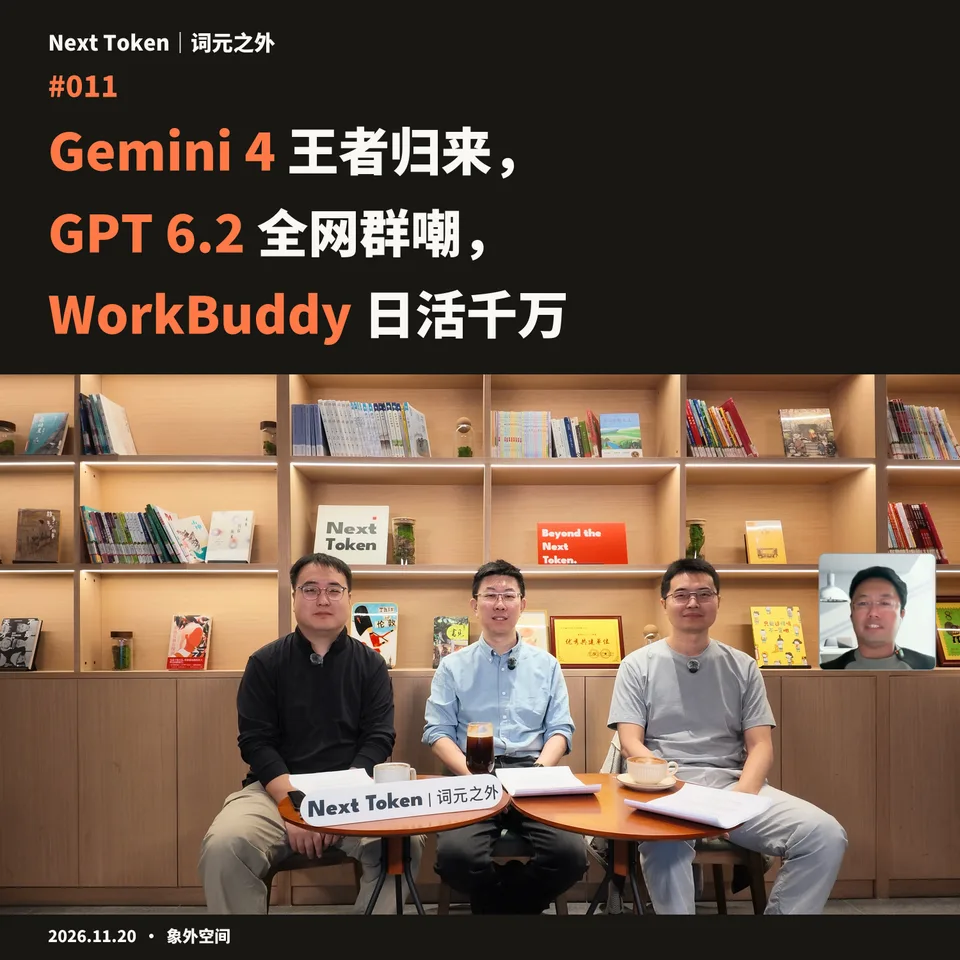
Welcome to Next Token #011. The hosts compare the latest frontier models, discuss the commercial pressures facing Chinese model developers, and look at the different paths personal agents are taking in China and overseas. Five topics lead the conversation:
-
GPT-6.2 Astra and Sol: why the backlash? Sol’s Ultra Fast mode feels quick and dependable, while Astra draws criticism for its price, frontend design, and argumentative responses. Astra’s detailed Blender modeling offers a different strength from Fable 5.2’s sense of composition and atmosphere. As everyday coding becomes easier, a one-prompt demo reveals less about the gap between models.
-
Gemini 4’s comeback: Neon’s writing and design. The hosts describe Carbon and Neon’s more natural writing, strong frontend design, and native understanding of animated references. They discuss a million-token context window, Neon’s ability to replace Opus 5.5 in real projects, and its availability in Google’s $19.99 subscription. Sergey Brin’s return comes up alongside the remaining frustrations with Antigravity’s harness.
-
DeepSeek’s free limits and the problem of token demand. Tighter limits on free long conversations in the DeepSeek app upset fanfiction and roleplay users, while API speed improves. The hosts ask why Chinese models struggle to attract paying usage when people earning money with AI pay for stronger overseas models and casual users seek free access.
-
Two products with 10 million daily users: WorkBuddy and Meta Muse. Tencent’s enterprise assistant and Meta’s personal agent illustrate different approaches. The discussion moves from cross-site shopping, shared browser context, and health advice to Apple’s personal-agent plans. The hosts ask why Chinese companies concentrate on office tasks and how compliance constraints and super-app habits affect consumer agents.
-
Qwen 4, Hunyuan Hy4 flash, and Anthropic’s IPO. Qwen4-Max and Hunyuan Hy4 flash arrive on the same day. WorkBuddy gives Hunyuan’s fast, inexpensive model a place to reach users. The closing market discussion covers Anthropic’s $83 offering price and valuation approaching $2 trillion, with SpaceX providing a comparison for concentrated wealth and the changing value of human work.
🎙️ Hosts and participants
- Guizang · Host on duty
- Yang Pan
- Orange
- Xiangyang Qiaomu · Joining remotely
Recorded at Xanadu Why Space in Beijing on November 20, 2026.
⏱️ Chapters
- 00:00 Opening highlights
- 01:53 Opening music
- 02:03 Opening introduction
- 02:42 Opening: 610,000 plays across ten episodes, and the website’s new transcript selection and export feature
Hands-on with frontier models
- 04:12 GPT-6.2 Astra and Sol: criticism on X and confusion over review versions
- 05:25 Sol Ultra Fast feels fast and economical; Astra is expensive, struggles with frontend design, and argues
- 08:22 Asking Astra to review Fable’s code: why does the review never end?
- 08:40 Three model personalities: experienced engineer Opus, language specialist Neon, and ordinary programmer Astra
- 11:14 Why evaluation is getting harder as expectations rise and everyday coding approaches saturation
- 15:28 Two approaches to 3D: Fable 5.2’s atmosphere versus Astra’s detailed Blender modeling
- 20:51 Gemini 4 Carbon, Neon, Argon, and Hydrogen: model relationships and pricing questions
- 23:44 Carbon and Neon make writing feel human again
- 27:07 Native multimodality: understanding and recreating fast animation, with design taste beyond Opus 5.5
- 28:49 DeepMind’s turnaround: printed criticism and Sergey Brin’s return
- 34:05 Neon joins Google’s $19.99 subscription, easing worries about losing model access
- 35:22 Where can you actually use Carbon?
Model evaluation and the tools around it
- 36:29 DeepSeek limits free long conversations: fanfiction and roleplay users react while the API speeds up
- 38:43 Why Chinese models struggle to grow token usage: premium overseas models or free access
- 42:05 Advice for model launches: show a complete real project instead of claiming to beat Opus 5.5
- 46:08 Building video graphics and automatic podcast highlights with Neon
- 48:40 Testing a million-token context window and generating a long article in one pass
- 49:27 Strong model, frustrating tools: Antigravity’s caching, permissions, and need for faster iteration
- 50:39 An Antigravity session fails: how do you resume a half-finished project?
Tencent’s earnings and the divide in personal agents
- 53:52 WorkBuddy passes 10 million daily users; WeChat’s Xiaowei reaches 30 million but still feels like an older chatbot
- 57:23 Why haven’t Chinese tech companies built a compelling personal agent?
- 58:36 Meta Muse reaches 10 million daily users: cross-site shopping and Shopify’s embrace of agents
- 59:16 Instinct’s everyday use cases and agent updates
- 01:01:57 Agents creating purchasing demand: digital pianos, lactase, and overseas supplements
- 01:05:03 Privacy and the trust flywheel: useful results encourage users to share health data and browser access
- 01:08:19 Apple’s personal-agent plans beyond Siri, and the case for cloud models
- 01:09:21 Smart-home assumptions and Ant’s different approaches with Lingguang and Afu
- 01:10:58 From smart-home readings to an assistant that works across devices
- 01:13:01 Pressure on Tencent and Kuaishou’s profits, compute spending, and the possibility of another ByteDance
- 01:15:49 Why personal agents lag in China: constrained model responses and mobile-internet habits
- 01:17:26 Subcast: subscribing to video podcasts and clipping highlights
- 01:18:01 Give employees tokens and ownership: internal startups without large teams and resources
Qwen 4, Hunyuan Hy4 flash, and Anthropic’s IPO
- 01:19:32 Qwen4-Max and Hunyuan Hy4 flash compete for position, with WorkBuddy as Hunyuan’s testing ground
- 01:22:03 Anthropic’s $83 IPO, a valuation approaching $2 trillion, and a comparison with SpaceX
Listener conversations and this week’s finds
-
01:25:06 Feedback on last week’s down jackets and thoughtful Xiaoyuzhou comments
-
01:27:11 A matte-screen iPad mini as a Mac mini display, connected directly or through Tailscale
-
01:30:23 Storage prices rise: a 1 TB SSD moves from ¥1,300 to ¥1,600, and used Android phones look attractive
-
01:31:48 GTA 6 impressions: PS5 trigger resistance, lively NPC stories, and future AI-powered open worlds
-
01:35:50 Backup coding options: Factory, Devin, and Google subscriptions
-
01:36:50 Closing
💡 Questions from the episode
Where does a model’s taste show up in 3D work?
Composition, lighting, and fog can make a scene convincing. The shape, materials, and textures of an individual object demand different skills. Separating these tasks helps explain why the hosts prefer different models for different work.
How different is building a feature from integrating it into an existing product?
The podcast highlights feature worked well because it reused the existing bilingual subtitle and editing workflow. A failed Antigravity session raised another question: how does the tool carry context into the next session? Both examples test whether the model and its tools can work with an existing project.
How much can a daily active user count tell us?
An occasional question, daily coding, and delegating an entire job can all count as activity. The hosts discuss these users’ different needs for free access, speed, and quality, and how an existing product such as WorkBuddy can bring a new model into everyday tasks.
What should a personal agent help with before asking for more context?
Comparing digital pianos against someone’s actual requirements tests whether an agent can explain tradeoffs. Training records and smart-home readings provide more personal context for useful reminders. The discussion follows how trust accumulates through use and what local and cloud models cost in practice.
🧩 Concepts
- Multimodality means working with text, images, audio, or video. An animation example tests whether a model understands how a visual changes over time.
- Harness refers to the environment that organizes a model’s tools, sessions, context, and task execution. The hosts discuss whether work can continue after a long session fails.
- Personal agent describes an assistant for ongoing individual use, drawing on preferences and context shared with permission to help with specific tasks.
- Trust flywheel describes a repeated process: useful results encourage continued use and more context, creating opportunities for more relevant help.
🔗 Tools and references discussed
More in the Wiki: Windsurf, WeChat’s Xiaowei, Siri, Ant Group, Lingguang, Afu, Kuaishou, SubCast, Xiaoyuzhou, Tailscale, PS5, Factory, Devin.
- Next Token Skill and Next Token Grok Bot · Tools introduced at the start of the episode for finding and citing past discussions.
- Genie 4 · Google DeepMind’s interactive world model, discussed in the segment on the team’s recent releases.
- GPT-6.2 and Fable 5.2 · Speed, code review, and 3D creation.
- Carbon and Neon, and Antigravity · Writing, video graphics, editing features, and session management.
- DeepSeek and WorkBuddy · Response speed, free access, and bringing models into office work. The hosts also discuss DeepSeek Harness as an alternative to the chat app.
- Instinct, Muse, and Grok Bot · Everyday personal-agent tasks, context, and continued use.
- SubCast · Video podcast subscriptions and highlight clips. The hosts also explain selecting multiple transcript passages on the Next Token website and giving the selection to an agent.
🔁 Related episode
- #010 Jensen Huang Resigns, Fable Changes the Game, and Language Is the World · Making games and ink-style interactions with Fable, and how a personal agent earns trust while planning travel.
💬 Join the conversation
What have you recently handed over to a personal agent? Which step did it save you, and what would you want it to remember? Share an example from your own experience.
About the show
Next Token is a video podcast, also available as audio, about AI technology, products, and their real-world effects. In the flagship Next Token Weekly, Yang Pan, Guizang, Orange, and Xiangyang Qiaomu share observations, practical experiences, and different perspectives.
Credits
Thanks to Xanadu Why Space for hosting the recording.
Music: Electric Dreams / Origami — Scott Buckley, CC BY 4.0; edited and mixed.